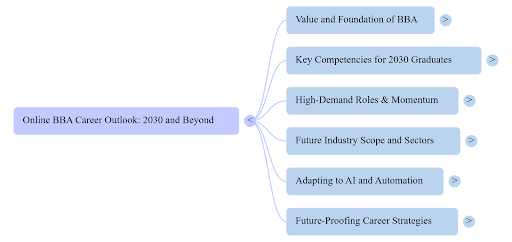
Globalisation, artificial intelligence, sustainability, and digital commerce are reshaping how organisations operate and compete. Remote work and automation have redefined roles that once depended on physical offices. In this context, the Online BBA has emerged as a dynamic qualification that blends business fundamentals with digital competencies suited to the economy of 2030 and beyond.
Why BBA Matters in 2030: Starting Early, Thinking Ahead
Choosing BBA after 12th enables learners to begin building managerial thinking, analytical discipline, and decision-making maturity at an early stage. The curriculum introduces finance, HR, marketing, digital business, and analytics—domains that will underpin leadership roles across sectors in the next decade.
Yes. Employers increasingly evaluate demonstrated skills, applied projects, and outcomes, provided the degree is from a UGC-entitled university.
Skills That Define the Graduate of 2030
Graduates who thrive in 2030 will combine business judgment with technology fluency. Key competencies include:
- Business analytics and data literacy: reading dashboards, spotting patterns, and translating insights into action.
- Digital marketing and brand strategy: executing performance campaigns and customer engagement across platforms.
- AI-assisted financial decisions: using automation for planning, forecasting, and risk assessment.
- Entrepreneurship and innovation: identifying opportunities and designing viable business models.
- Leadership in hybrid workplaces: managing distributed teams and collaborating virtually.
- Cross-cultural communication: operating effectively in global teams.
- Sustainability and ESG awareness: aligning profit with responsible practices.
Analytical thinking, digital literacy, problem-solving, communication, and the ability to use data in decision-making.
High-Salary Roles and Career Momentum by 2030
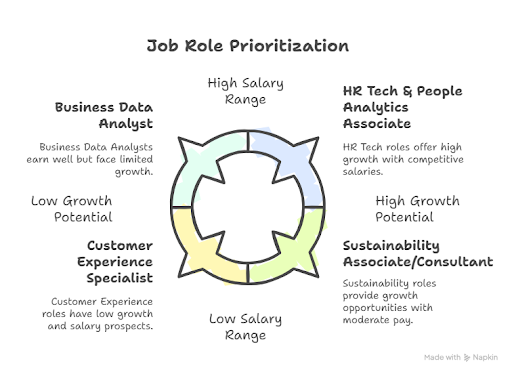
While salaries vary by sector and location, the following roles are expected to retain strong demand. Indicative entry-level ranges are provided to guide expectations in India:
- Digital Business Manager (early roles in growth/operations): typically ₹5–9 LPA; growth with ownership of funnels and automation.
- Business Data Analyst: typically ₹6–10 LPA; higher for analytics-heavy teams.
- Brand & Social Media Strategist: typically ₹4–8 LPA; performance-linked growth common.
- Customer Experience Specialist: typically ₹4–7 LPA; expands with product and UX exposure.
- HR Tech & People Analytics Associate: typically ₹5–8 LPA; fastest growth in tech-forward firms.
- Sustainability Associate/Consultant (entry roles): typically ₹5–9 LPA; cross-functional exposure adds value.
- Startup Operations Manager (early stage): typically ₹5–9 LPA; equity/performance incentives possible.
Top recruiters (illustrative): Accenture, Deloitte, KPMG, EY, TCS, Infosys, Wipro, HCLTech, Amazon, Flipkart, Meesho, Zomato, Swiggy, Paytm, Razorpay, Freshworks, Zoho, Lenskart, Tata Group companies, Aditya Birla Group.
Data-linked business roles, growth/marketing strategy, people analytics, CX design, sustainability projects, and technology-enabled operations.
The Expanding Online Career Scope
The online BBA career scope spans AI-enabled services, fintech, e-commerce, global business services, and data-driven consulting. Employers value graduates who understand both technology and management, and who can translate dashboards and models into practical decisions.
AI, Automation, and Data: The New Language of Business
AI has moved from aspiration to infrastructure. Marketing automation, forecasting models, programmatic media, workforce analytics, and conversational tools now inform everyday decisions. Graduates who can interrogate data quality, interpret outputs, and recommend actions will lead cross-functional teams.
Develop comfort with analytics platforms, basic scripting or low-code tools, and AI-assisted productivity applications; practise interpreting metrics and presenting decisions.
Why Early Internships Strengthen Outcomes
The BBA degree online for working professionals and full-time students alike supports internships, freelancing, and part-time roles during study. Early workplace exposure sharpens decision-making, time management, and stakeholder communication—capabilities that accelerate transitions into full-time roles.
Applying Knowledge in Real Time:
- Run small digital campaigns for a local business.
- Analyse sales or expense data for a family enterprise.
- Support customer success or operations as a part-time associate.
- Compile a portfolio of projects (dashboards, campaign reports, SOPs).
Careers 2030: Where the Opportunities Lie
Fast-growing sectors: E-commerce and marketplaces, fintech and digital payments, AI and analytics services, HR technology, green energy and sustainability, digital media and content, cross-border D2C.
Stable/continuing sectors: Banking and financial services, manufacturing, retail and distribution, logistics and real estate, healthcare services, and public administration projects.
Start-ups, multinational corporations, consulting firms, and technology-enabled enterprises across the sectors listed above.
The Entrepreneurial Edge
By 2030, entrepreneurship will be mainstream. Opportunities include niche e-commerce, performance-marketing agencies, analytics support services, creator-economy ventures, and tech-enabled small businesses. The Online BBA’s blend of strategy, finance, operations, and digital execution provides a practical runway for first-time founders.
How to Future-Proof a Business Career
- Master new tools continuously (analytics suites, automation, AI assistants).
- Build an evidence-based portfolio (campaigns run, dashboards built, processes improved).
- Seek internships, live projects, and competitions each semester.
- Network through professional platforms, industry forums, and alumni groups.
- Add micro-credentials in analytics, communication, or project management.
The Road Ahead: Why the Future Looks Bright
The decade ahead will reward professionals who blend business intelligence with technology fluency and responsible leadership. Online BBA graduates will stand out not only for what they know but for how quickly they apply knowledge in complex, evolving contexts. Rather than fitting into the future of business, they will increasingly help define it.
