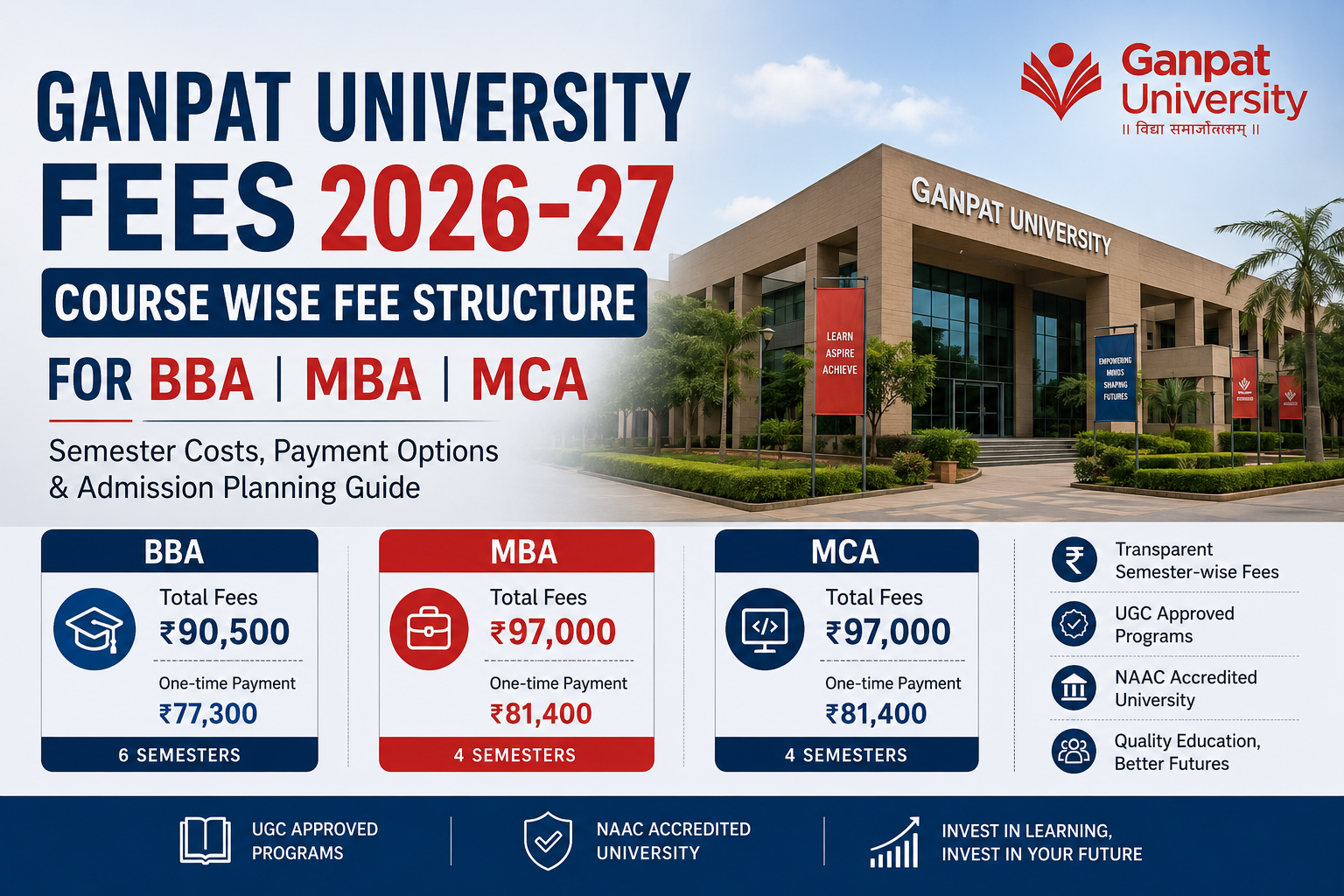
Most students spend weeks shortlisting universities based on rankings, placement records, and campus photos. But here's what actually trips people up: by the time they sit down to calculate the Ganpat University courses and fees, the admission deadline is two days away, a parent is asking hard questions, and the budget conversation hasn't even started.
That's not a planning failure; it's a system failure. Fee structures in Indian universities are notoriously fragmented. You'll find the tuition on one page, examination fees buried in a brochure, and the registration charge somewhere in the admission portal. By the time you add it all up, the number looks very different from what you expected.
This blog does the math for you clearly, completely, and with the context you actually need to make a decision.
What the Fee Structure Is Actually Telling You
A common pattern in how universities price their programmes is to lead with the tuition number and let everything else, such as registration, examination, and enrollment, appear as footnotes. When you look at the Ganpat University fee structure 2026, something different stands out: the fees are structured to be transparent and semester-wise, which means you're not hit with a large lump sum upfront.
The hidden implication here is financial planning flexibility. A student who knows exactly what each semester costs can plan part-time work, family support, or an education loan in smaller tranches rather than one large disbursement. That's a structural advantage that most students overlook when they're only comparing 'total fees' across institutions.
There's also a contrarian insight worth considering: a lower total fee doesn't always mean lower value, but it does shift the question from 'can I afford this?' to 'what am I getting for this?' That's a sharper, more productive lens.
The Conversation That Happens at Every Kitchen Table
In most cases, the fee conversation in Indian families happens in two rounds.
The first is exploratory: 'How much does it cost?'
The second is serious: 'Is this the right use of money?'
The problem is that both conversations often happen with incomplete information.
For a working professional considering an MBA, the question isn't just about fees; it's about opportunity cost. For a fresh graduate choosing between BBA and direct job entry, the question is about the return on a three-year investment. For parents funding an MCA, the question is whether tech roles actually hire from this programme.
One of the biggest gaps in how students research programmes is that they compare fee totals without comparing what those fees actually buy: curriculum depth, industry connections, credential credibility, and post-programme outcomes. The fee structure is the entry point, not the conclusion.
Who Should Be Seriously Looking at This & Who Shouldn't
The BBA makes sense if:
- You're a Class 12 graduate who wants a structured business foundation before entering the workforce or pursuing an MBA
- You come from a business family and want formal training to complement hands-on exposure
- You're cost-conscious at ₹90,500 total (or ₹77,300 with one-time payment), it's among the more accessible BBA programmes in Gujarat
The MBA makes sense if:
- You have 1–3 years of work experience and want to formalise your business acumen with a recognised postgraduate credential
- You're looking to shift domains operations to marketing, finance to strategy and need the credibility that a degree provides
- You want campus-based learning rather than online, which still matters significantly to mid-market employers
The MCA makes sense if:
- You have a BCA, B.Sc. (IT/CS), or equivalent undergraduate background and want to move into software development, data, or systems roles
- You're targeting tech roles in mid-size companies or IT service firms where an MCA is still a preferred credential over a raw BCA
- You want two more years of structured learning with faculty mentorship before entering the job market
When to pause and reconsider:
- If you're choosing a programme purely based on fee affordability without evaluating placement outcomes, think twice
- If you're a working professional who can access executive or online MBA programmes with more flexible scheduling, a full-time MBA may not be optimal
- If you already hold a strong BCA or B.Sc. with internship experience, evaluate whether the MCA adds enough career acceleration to justify two years
Why Structure Matters More Than the Sticker Price
The Ganpat University UGC approved courses carry a credential weight that matters in the Indian job market. UGC approval is not cosmetic; it determines whether your degree is recognised for government jobs, higher studies abroad, and competitive examinations. This is a baseline that students often forget to verify until it's too late.
What a well-structured programme like BBA, MBA, or MCA at a recognised university actually provides is a learning-to-career translation path, not just a degree. The BBA builds analytical and communication foundations that feed into management roles. The MBA creates a leadership framework around real business functions. The MCA converts technical aptitude into industry-deployable software skills. The fee you pay is, in effect, buying structured acceleration toward a specific career trajectory.
BBA Fee Structure: Semester-Wise Breakdown
The Ganpat University BBA fees follow a six-semester structure over three years. Here's the complete breakdown:
| Fee Component | Sem I | Sem II | Sem III | Sem IV | Sem V | Sem VI |
|---|---|---|---|---|---|---|
| Registration Fee | ₹5,000 | – | – | – | – | – |
| Enrollment (per year) | ₹2,000 | ₹2,000 | ₹2,000 | ₹2,000 | ₹2,000 | ₹2,000 |
| Examination (per year) | ₹2,000 | ₹2,000 | ₹2,000 | ₹2,000 | ₹2,000 | ₹2,000 |
| Tuition Fee (per sem) | ₹6,500 | ₹11,000 | ₹11,000 | ₹11,000 | ₹11,000 | ₹11,000 |
| Total Fees (Semester-wise) | ₹90,500 across 6 semesters | |||||
For students or families who prefer to clear the financial commitment upfront, the one-time payment option offers a meaningful saving:
| Payment Option | Amount | Savings |
|---|---|---|
| Semester-wise (standard) | ₹90,500 | – |
| One-time Full Payment | ₹77,300 | ~20% off on tuition |
The 20% discount applies specifically to the tuition fee component. Registration, enrollment, and examination charges remain unchanged. This means the actual saving is approximately ₹13,200, which could cover a semester's living expenses or study materials.
MBA Fee Structure: What Each Semester Actually Costs
The Ganpat University MBA fees per semester are structured across four semesters. Semester I is typically the most intensive in terms of coursework and carries a slightly lower tuition, a structure that eases the initial financial load.
| Fee Component | Sem I | Sem II | Sem III | Sem IV |
|---|---|---|---|---|
| Registration Fee | ₹5,000 | – | – | – |
| Enrollment (per year) | ₹2,000 | ₹2,000 | ₹2,000 | ₹2,000 |
| Examination (per year) | ₹2,500 | ₹2,500 | ₹2,500 | ₹2,500 |
| Tuition Fee (per sem) | ₹15,500 | ₹19,500 | ₹19,500 | ₹19,500 |
| Total Fees (Semester-wise) | ₹97,000 across 4 semesters | |||
One-time payment option:
| Payment Option | Amount | Savings |
|---|---|---|
| Semester-wise (standard) | ₹97,000 | – |
| One-time Full Payment | ₹81,400 | ~20% off on tuition |
At ₹81,400 all-in (one-time payment), this places the MBA in a competitive bracket for campus-based postgraduate management programmes in Gujarat, particularly for students weighing private university fees against outcome potential.
MCA Fee Structure: Breaking Down the Two-Year Investment
The Ganpat University MCA fees mirror the MBA in structure, four semesters, same fee components, same total. That parallel is worth noting: the university values the MCA at the same level as the MBA, which reflects a deliberate positioning of the programme as a serious postgraduate credential rather than a bridging course.
| Fee Component | Sem I | Sem II | Sem III | Sem IV |
|---|---|---|---|---|
| Registration Fee | ₹5,000 | – | – | – |
| Enrollment (per year) | ₹2,000 | ₹2,000 | ₹2,000 | ₹2,000 |
| Examination (per year) | ₹2,500 | ₹2,500 | ₹2,500 | ₹2,500 |
| Tuition Fee (per sem) | ₹15,500 | ₹19,500 | ₹19,500 | ₹19,500 |
| Total Fees (Semester-wise) | ₹97,000 across 4 semesters | |||
One-time payment option:
| Payment Option | Amount | Savings |
|---|---|---|
| Semester-wise (standard) | ₹97,000 | – |
| One-time Full Payment | ₹81,400 | ~20% off on tuition |
For tech-focused students, ₹81,400 for a two-year MCA that translates directly into developer, analyst, or systems roles is a reasonable proposition, especially compared to private coding bootcamps that charge comparable amounts for six months of training without a recognised degree.
Where These Credentials Are Heading Over the Next 3–5 Years
The demand signal for management and tech graduates in India isn't weakening; it's shifting. Employers are increasingly looking for graduates who combine domain knowledge with digital fluency. A BBA graduate who understands data basics has a different market value than one who doesn't. An MCA graduate who can work across cloud environments is more hireable than one trained on legacy systems.
Universities that update their curriculum to reflect these shifts, integrating analytics, AI tools, and business communication into foundational programmes, will produce graduates with stronger early-career traction. The fee you pay today is partly a bet on whether the institution is keeping pace.
Ganpat University NAAC accreditation is a signal worth factoring into this bet. NAAC accreditation evaluates academic quality, infrastructure, research output, and student outcomes, not just infrastructure. It's one of the more reliable proxies available to students who can't spend weeks evaluating a university from the inside.
What to Take Away from This
- The semester-wise fee structure across BBA, MBA, and MCA allows for distributed financial planning, not just affordability, but manageability
- The one-time payment option saves approximately ₹13,200 on BBA and ₹15,600 on MBA/MCA, worth calculating if you have the capital
- UGC approval and NAAC accreditation are non-negotiable checkboxes; they determine long-term credential validity, not just present reputation
- Choose the programme based on where you are in your career journey, not just on fee comparison with other institutions
- The right time to pursue any of these is when you have clarity on the career direction. The programme is the map, not the destination
Frequently Asked Questions
The total semester-wise fee for the BBA programme is ₹90,500 across six semesters. Students who opt for the one-time full payment benefit from a 20% reduction on the tuition fee component, bringing the total down to approximately ₹77,300. The registration, enrollment, and examination charges remain the same under both payment options.
The MBA programme spans four semesters with a total fee of ₹97,000. Semester I is priced slightly lower, with a tuition fee of ₹15,500 (compared to ₹19,500 in subsequent semesters), plus the one-time registration fee of ₹5,000. Each semester also carries ₹2,000 for enrollment and ₹2,500 for examination. Choosing the one-time payment route reduces the total to ₹81,400.
A common pattern among students evaluating MCA options is to compare only tuition totals. The more useful comparison includes programme quality signals: UGC approval status, faculty background, placement support, and curriculum relevance to current tech roles. At ₹97,000 (semester-wise) or ₹81,400 (one-time), the MCA is competitively priced for a campus-based, UGC-recognised postgraduate degree in computer applications. The credential is recognised for further studies, government positions, and private sector roles.
Yes, the BBA, MBA, and MCA programmes are offered under the UGC-approved framework. This is important for several reasons: it ensures the degree is valid for competitive examinations, higher study applications (including abroad), and government sector eligibility. Students should always verify this directly on the university's official website or the UGC's approved institutions list before enrolling.
NAAC accreditation is an independent assessment of an institution's academic and administrative quality. For students, it acts as a third-party signal that the university meets established standards in curriculum delivery, faculty quality, research, and student support. It also matters for students considering further studies abroad; many foreign universities and scholarship bodies require applicants to come from NAAC-accredited institutions. It's not a guarantee of placement outcomes, but it is a meaningful quality marker when comparing institutions.
