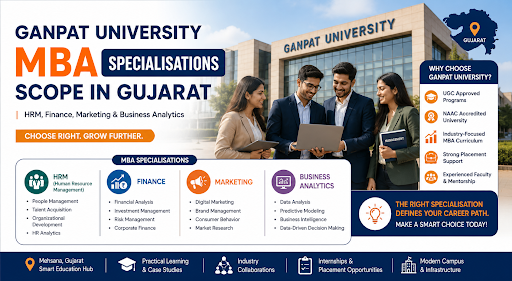
Most students spend months deciding whether to do an MBA. They spend about forty-eight hours deciding which specialisation to pick. That imbalance is where most early-career regret originates.
The specialisation you choose inside an MBA programme isn't a course selection; it's a career bet. It shapes the internships you're eligible for, the electives you access, the peer network you build, and crucially, how you're positioned when you walk into a placement interview. Changing your mind in Semester III is possible but expensive in time, opportunity, and sometimes academically.
What makes this decision harder in 2026 is that the job market has shifted under every specialisation simultaneously. HRM is no longer purely administrative. Finance is being reshaped by automation. Marketing has split into digital and traditional streams with very different skill requirements. And Business Analytics has gone from a niche track to one of the most sought-after MBA profiles in the country. Understanding what each of these actually means today, not five years ago, is the starting point.
What the Market Is Actually Asking For Right Now
The pattern across hiring data in 2026 is consistent: employers are no longer recruiting for job titles alone; they're recruiting for skill combinations. An HR professional who understands workforce analytics is more hireable than one who doesn't. A finance graduate who can model scenarios in Python has a different offer bracket than one who can't. A marketing hire who understands attribution models commands more than one who runs only on intuition.
This isn't about every MBA student needing to become technical. It's about understanding that every specialisation now has a digital dimension and the programmes that build that dimension into their curriculum are producing graduates with more versatile early-career profiles.
The hidden implication here is that the MBA Specialisation Scope question has changed. It's no longer 'which domain do I want to work in?' It's closer to 'which domain do I want to anchor, and how do I want to combine it with the emerging tools reshaping that domain?' That's a more productive and more honest frame for making this decision.
HRM: The Specialisation That Looks Soft Until You Understand What It Actually Does
The MBA HRM Ganpat University specialisation is often misread as the 'people person' track chosen by students who aren't sure what else to do. That reading is increasingly inaccurate.
Modern HR is a strategic function. In companies with 200+ employees, the HR Business Partner role is a boardroom-adjacent position responsible for workforce planning, leadership pipeline development, compensation benchmarking, and organisational design. In startups, the first HR hire often defines whether the company can scale its culture as it grows from 20 to 200 people.
What's changing in HRM specifically is the analytics layer. HR departments are now expected to produce data on attrition risk, engagement scores, time-to-hire efficiency, and return on learning investment. Students who graduate with both the people skills and the analytical tools to measure them are entering a talent market where the demand is outpacing supply.
Who this works for:
- Students who are genuinely drawn to organisational dynamics, people development, and workplace culture, not those who are avoiding quantitative tracks
- Students targeting large corporates, FMCG companies, IT services firms, or the growing HR consulting space
- Students who want a function with genuine upward mobility from HR Executive to CHRO have a 10–15-year path, but it's a real one
Finance: The Evergreen Track With a Rapidly Changing Skill Set
If there's a specialisation that has consistently produced strong early-career outcomes across economic cycles, it's finance. The MBA Finance Ganpat University track prepares students for roles in corporate finance, banking, financial planning, risk management, and investment sectors that exist in every industry, not just financial services.
The shift happening in finance right now is automation's impact on the transactional layer. Bookkeeping, reconciliation, and basic reporting are being absorbed by software. What's growing is demand for graduates who can interpret financial data, build scenario models, communicate financial risk to non-finance stakeholders, and make recommendations under uncertainty. That's a fundamentally different skill set from what a finance graduate needed ten years ago.
One pattern worth noting: finance is the specialisation with the widest range of post-MBA paths. A finance graduate can move into investment banking, corporate treasury, financial consulting, fintech product roles, or even entrepreneurship with a strong financial foundation. That range makes it one of the more resilient long-term bets.
Who this works for:
- Students who are comfortable with numbers and want to build a career in corporate finance, banking, or financial services
- Students targeting the CFO track, which typically requires finance depth at the MBA level
- Students open to sectors beyond financial services: manufacturing, healthcare, real estate, and infrastructure all have significant finance functions
Marketing: The Specialisation That's Split in Two & You Need to Pick a Side
The MBA Marketing Gujarat landscape has changed more visibly than any other specialisation over the past five years. The emergence of D2C (direct-to-consumer) brands, performance marketing, and data-driven campaign management has created a hard split inside the marketing function: traditional brand and strategy marketing on one side, digital and performance marketing on the other.
This isn't a good/bad distinction; both tracks have strong career paths. Brand and strategy marketing tends to dominate in FMCG, automotive, and large consumer companies. Digital and performance marketing is dominant in e-commerce, startups, SaaS, and any brand that sells directly online. The salaries, tools, and career arcs are meaningfully different between the two.
A common pattern among marketing MBA graduates who struggle early in their careers is that they studied marketing broadly without developing depth in either track. The students who do well tend to be those who use their electives, internships, and live projects to develop actual campaign execution experience, not just marketing theory.
Who this works for:
- Students who want to build brands, develop consumer insight, or work in the creative and strategic layer of marketing
- Students targeting FMCG, consumer goods, media, or digital-first companies
- Students who are willing to supplement MBA learning with hands-on digital tool exposure to analytics platforms, CRM systems, and campaign management tools
Business Analytics: The Fastest-Growing MBA Track With the Steepest Learning Curve
Ask any MBA placement office what specialisation has seen the sharpest increase in employer interest over the last three years, and the answer is consistently analytics. The Business Analytics MBA Gujarat track is no longer a niche offering; it's becoming a core employment pathway for MBA graduates entering consulting, product management, supply chain, marketing operations, and financial analysis.
What employers are hiring for in this space isn't advanced data science; that's a different profile. They're hiring for business-oriented analysts who can take a messy dataset, apply structured thinking to it, and produce a recommendation that a leadership team can act on. The tools matter (SQL, Excel, Tableau, basic Python), but the thinking matters more.
The honest challenge with this specialisation is the learning curve. Students who come in expecting a mostly management-oriented programme and encounter statistical methods, data visualisation, and quantitative modelling in their first semester often find it harder than expected. The students who thrive are those who come in curious about data and willing to build technical muscle during the programme.
Who this works for:
- Students with a quantitative undergraduate background (engineering, statistics, commerce with maths) who want to stay in the analytical space but move into business roles
- Students targeting consulting, strategy, product, or operations functions where data literacy is now table stakes
- Students who want early-career differentiation: analytics profiles are still less common than finance or marketing graduates at the MBA level, which creates relative scarcity value
Side-by-Side: How the Four Specialisations Stack Up
| Criteria | HRM | Finance | Marketing | Business Analytics |
|---|---|---|---|---|
| Best suited for | People-oriented, communicators | Analytical, numbers-driven | Creative + strategic thinkers | Quantitative, tech-curious |
| Core skill built | Talent strategy & org. design | Financial modelling & planning | Consumer insight & brand strategy | Data interpretation & decision models |
| Entry-level roles | HR Executive, Recruiter, L&D Coordinator | Financial Analyst, Credit Analyst | Brand Executive, Sales Manager | Data Analyst, BI Analyst |
| Mid-career growth | HR Business Partner, HR Manager | CFO track, Investment roles | Marketing Manager, Category Head | Analytics Manager, Strategy Consultant |
| Demand trajectory | Stable + growing in startups | Strong across all sectors | Expanding in D2C & digital | Fastest-growing specialisation |
| Avg. early salary (India) | ₹4–7 LPA | ₹5–9 LPA | ₹4–8 LPA | ₹6–10 LPA |
Note on salary ranges: these are indicative early-career figures for management graduates across India. Actual outcomes vary by location, company size, individual performance, and negotiation. Use these as directional signals, not benchmarks.
What You're Actually Studying: A Curriculum Snapshot
One of the most underused tools in specialisation selection is the syllabus. The Ganpat University MBA Syllabus across specialisations is structured to move from foundational business concepts in Semesters I and II to specialisation-specific depth in Semesters III and IV, the standard two-year MBA architecture.
The practical implication of this structure is that every student, regardless of specialisation, builds a shared business foundation in the first year. The differentiation happens in the second year, which is also when internship exposure, industry projects, and elective choices define the career signal you're sending to employers. Here's a snapshot of what each track covers:
| Specialisation | Core Focus Areas | Applied Learning |
|---|---|---|
| HRM | Organisational Behaviour, Talent Acquisition, Learning & Development, Labour Laws, Performance Management, HR Analytics | Case-based HR policy design, conflict resolution simulations, workforce planning exercises |
| Finance | Financial Accounting, Corporate Finance, Investment Management, Risk Analysis, Financial Derivatives, Taxation | Financial modelling, case studies on M&A, budgeting simulations, live market analysis |
| Marketing | Consumer Behaviour, Brand Management, Digital Marketing, Sales & Distribution, Market Research, Integrated Communications | Campaign projects, brand audits, go-to-market strategy exercises, D2C case analysis |
| Business Analytics | Data Visualisation, Predictive Analytics, Business Intelligence, Statistical Methods, SQL & Python Basics, Decision Modelling | Live dataset projects, BI tool practicals (Tableau/Power BI), business case simulations |
A pattern insight worth noting: the most sought-after profiles at the postgraduate level in 2026 are combinations of an HRM graduate with HR analytics exposure, a finance graduate with financial modelling skills, and a marketing graduate with digital attribution experience. The core specialisation gives you the domain; what you build around it gives you the edge.
The Mehsana Advantage and What the Investment Looks Like
For students based in or around North Gujarat, Ganpat University Mehsana MBA is a relevant geographic consideration. The campus location in Mehsana gives students access to one of Gujarat's active industrial corridors, manufacturing, chemicals, pharmaceuticals, and agri-business, which has direct relevance for finance, marketing, and supply chain-oriented MBA graduates looking to work in the region.
In terms of investment, the MBA Fees in Ganpat University for the two-year programme total ₹97,000 on a semester-wise basis. Students who can manage the full payment upfront benefit from a 20% reduction on the tuition component, bringing the total to ₹81,400. For a campus-based, NAAC-accredited MBA with a four-specialisation offering and active industry body connections, this places the programme in a competitive fee bracket for the region.
| Payment Option | Total Amount | Notes |
|---|---|---|
| Semester-wise (standard) | ₹97,000 | Spread across 4 semesters |
| One-time Full Payment | ₹81,400 | ~20% saving on the tuition component |
What the MBA Is and What It Isn't
The Ganpat University MBA is a two-year, campus-based management programme with four specialisation tracks. What it offers is structured: a foundational management curriculum, specialisation depth, industry body connections, and an NAAC-backed credential. What it requires from the student is equally structured: active use of placement infrastructure, engagement with industry events, and a genuine commitment to building domain skills beyond the classroom.
An MBA at any institution is a multiplier, not a guarantee. It amplifies what you bring in your curiosity, your communication skills, and your willingness to put yourself in uncomfortable learning situations. Students who treat it as a passive credential often leave with exactly that. Students who treat it as two years of structured industry proximity tend to exit with something more durable.
Where Each Specialisation Is Heading Over the Next 3–5 Years
HRM will increasingly intersect with workforce technology, HRMS platforms, people analytics, and AI-assisted hiring. HR graduates with this exposure will have a meaningfully different career trajectory than those without it.
Finance will bifurcate: transactional finance roles will continue to shrink, while strategic finance, risk advisory, and fintech-adjacent roles will grow. The value of the MBA credential in finance is in preparing for the growth side of that bifurcation.
Marketing will continue its shift toward performance accountability brands are demanding measurable returns on every rupee spent. Marketing graduates who can connect creative strategy to conversion metrics will be the most sought-after profile.
Business Analytics will likely become the baseline expectation rather than the differentiator within 5 years. Students choosing this track now are ahead of the curve, but the window for scarcity value is closing.
What to Take Away From This
- There is no objectively 'best' MBA specialisation; there is only the best fit for your strengths, career direction, and the industry context you're entering
- HRM rewards people-oriented students with a growing analytical layer; Finance rewards analytical students with strategic ambition; Marketing rewards creative students who are willing to add digital depth; Business Analytics rewards quantitative students who want business impact
- The first-year MBA curriculum is shared specialisation depth happens in year two, which is when your internship and project choices define your employer signal
- At ₹97,000 (semester-wise) or ₹81,400 (one-time), the programme's cost-to-credential ratio is competitive for a NAAC-accredited, campus-based MBA in Gujarat
- The right time to choose a specialisation is after honest self-assessment, not based on what sounds impressive or what a senior suggested
Frequently Asked Questions
Placement scope depends on the industry you're targeting, not just the specialisation name. In Gujarat's context, Finance and Business Analytics tend to produce the widest range of early-career options in Finance because every industry has a finance function, and Analytics because demand is outpacing supply. Marketing works well for students targeting FMCG, consumer brands, and digital companies. HRM is strong in IT services, manufacturing, and large corporates with structured people functions. Rather than chasing the 'best' specialisation, identify the industry you want to work in and then map which specialisation gives you the most relevant entry point.
The How About HRM Ganpat University curriculum covers organisational behaviour, talent acquisition, learning and development, performance management, labour laws, and increasingly, HR analytics. The practical layer includes case studies, conflict resolution simulations, and workforce planning exercises. The honest answer on 'how practical' any curriculum is: it depends on how much the student engages with live projects, internships, and industry guest sessions, not just what's on the syllabus. HRM as a function rewards students who actively seek real exposure to people's challenges, not those who study it from a theoretical distance.
Yes, but with a realistic expectation of the learning curve. Business Analytics at the MBA level is oriented toward business decision-making with data, not software development or data science. Students from commerce, economics, or social science backgrounds can absolutely build the required skills, but they'll need to invest time in the quantitative and tool-based components of the programme. The differentiating factor for non-engineering students is usually strong communication and business reasoning, which are genuine assets in analytics roles, where the ability to explain findings to non-technical stakeholders is as valuable as technical skill.
In most Indian MBA programmes, the specialisation structure means that Semesters I and II are common across all tracks, with specialisation-specific courses beginning in Semester III. Officially switching after Semester II depends on the university's academic policy it's worth clarifying this directly with the admissions or academic office. In practice, what students can do is use elective choices, internship projects, and thesis work to develop skills adjacent to a different specialisation even while formally enrolled in one track. The cleaner approach is to do thorough research before Semester I begins.
The total programme fee is ₹97,000 on a semester-wise payment basis. Students who opt for a one-time full payment benefit from approximately 20% savings on the tuition component, bringing the total down down to ₹81,400. The difference of roughly ₹15,600 is meaningful, particularly for students whose families can manage the upfront commitment. The semester-wise option spreads the cost over four semesters, which is the more common choice for students managing the fee through part-time income, family support, or an education loan. Either way, the total investment for a four-semester, NAAC-accredited management degree is competitive within the Gujarat private university market.
