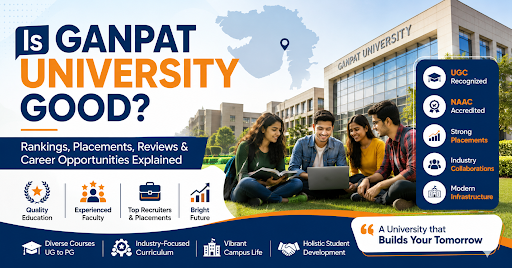
Every year, thousands of students type some version of this question into a search bar. They're not looking for a brochure. They're not looking for a list of facilities. They're trying to figure out whether two or three years of their life and a significant financial commitment are going to take them somewhere meaningful.
The problem is that most of what comes up in response is either promotional content from the university itself or generic review aggregators that mix five-year-old opinions with current data. Neither is particularly useful when you're trying to make an informed decision in 2026.
So here's an attempt at something more honest: a structured look at what the rankings actually mean, what the placement ecosystem looks like, what the accreditations signal, and where this institution genuinely fits in the landscape of higher education choices available to you today.
What Rankings Actually Measure and What They Don't
Before diving into where the university stands, it's worth addressing a pattern that shows up constantly in how students use ranking data. Most students treat a Ganpat University Ranking 2026 figure as a pass/fail verdict. That's not how rankings work, and relying on them that way leads to poor decisions.
Rankings measure a combination of inputs and outputs: teaching quality (faculty-student ratio, qualifications), research output (publications, citations), industry perception, graduate outcomes, and infrastructure. Different ranking bodies weigh these differently. NIRF, for instance, weights research and perception heavily, which tends to favour older institutions with larger PhD programmes. That doesn't mean a younger, industry-aligned university with strong placement outcomes is a worse choice for an undergraduate or professional master's degree.
The more useful question isn't 'what rank is this university?' but 'what does this university rank highly on, and does that match what I need?' A university with strong industry partnerships and a NAAC accreditation but a moderate NIRF rank may be a better professional launchpad than a higher-ranked institution with weaker placement infrastructure.
Reading the Recognition Signals the Right Way
The Ganpat University NAAC A+ Grade accreditation is probably the most consequential credential signal for students to understand. NAAC (National Assessment and Accreditation Council) is a government-established body that evaluates universities on seven criteria: curricular aspects, teaching-learning, research, infrastructure, student support, governance, and institutional values.
An 'A' grade from NAAC means the institution has cleared a rigorous peer-review process across all seven dimensions. For students, this matters in three direct ways: your degree is valid for government job applications, your application for higher studies abroad is credible (many foreign universities require NAAC accreditation as a baseline), and your employer has a third-party quality signal to reference when evaluating your credentials.
Beyond NAAC, the recognition from NIRF, GSIRF (a Government of Gujarat institutional rating), ARIIA 2021 (Atal Innovation Mission's ranking on innovation achievements), and editorial rankings in India Today and Outlook provide a multi-source picture. When several independent bodies, government, state, and editorial converge on recognising the same institution, it's a more reliable signal than any single data point.
| Recognition / Award | Body | Significance |
|---|---|---|
| NAAC 'A' Grade Accreditation | NAAC (Govt. of India) | Academic quality benchmark credential validity for jobs, higher studies, & abroad applications |
| NIRF Ranking | Ministry of Education, India | National framework that evaluates teaching, research, outreach, & perception |
| GSIRF Rating | Govt. of Gujarat (ICARE Ratings) | State-level institutional rating assessing research and academic performance |
| ARIIA 2021 Ranking | Atal Innovation Mission / AICTE | Ranks institutions on innovation & startup ecosystem strength |
| ASSOCHAM Recognition | ASSOCHAM India | Industry body acknowledgement of institutional quality and industry relevance |
| Featured in India Today & Outlook | National Media Rankings | Third-party editorial rankings used by students and parents for comparison |
One contrarian insight worth noting: editorial rankings like India Today and Outlook are survey-based and perception-weighted. They're useful as awareness signals; they tell you the institution is visible and considered relevant, but they shouldn't carry more weight than NAAC or NIRF when you're making an enrolment decision.
What Students Are Actually Trying to Figure Out
Here's how the decision conversation usually goes. A student shortlists three or four universities. One is a well-known name in a metro city with high fees. Another is a state university with lower fees but uncertain placement support. And then there's an option like this, a NAAC-accredited, multi-faculty university in Gujarat with a visible industry network but perhaps less name recognition in a student's immediate social circle.
The confusion isn't about quality; it's about confidence. Students worry about how the degree will be perceived by employers in Ahmedabad, Surat, Mumbai, or Bangalore. They worry about whether the placement office actually delivers or just looks good on the website. And they worry about whether the peer group on campus will push them forward or hold them back.
These are legitimate concerns, and no blog can fully resolve them. What a blog can do is give you the structural signals to interpret and help you ask better questions when you visit the campus or speak to current students.
The Placement Picture: Infrastructure vs. Outcomes
The Ganpat University Placement ecosystem is built on a foundation that most students underestimate: institutional tie-ups with industry bodies, not just individual companies. There's a structural difference between a university that has an MOU with ten companies and one that is connected to industry associations that collectively represent thousands of employers across sectors.
The industry associations connected to the university span management, technology, chemicals, services export, and national commerce bodies. This isn't a curated shortlist; it represents a cross-section of Gujarat's and India's business ecosystem, from large corporates to SMEs to export-oriented service firms.
In most cases, students who perform well academically and are placement-ready, with strong communication, relevant internship experience, and domain knowledge, find that the network available through these associations opens doors beyond what a standard placement drive would. The common pattern here is that students who treat placement support as a passive service tend to underutilise it, while those who actively engage with industry events, guest lectures, and association-linked networks tend to see better early-career outcomes.
| Industry Body / Association | Relevance to Students |
|---|---|
| CII (Confederation of Indian Industry) | National industry network; access to corporate events, mentors & hiring forums |
| FICCI | Policy-level industry body; exposure to the national business ecosystem |
| ASSOCHAM India | Multi-sector industry body; relevant for management and commerce students |
| AIMA (All India Management Association) | Management-specific body; certification pathways and career credibility for MBA students |
| GESIA (Gujarat IT/ITeS Association) | Key tech industry body in Gujarat; critical for MCA/tech placements |
| Gujarat Chemical Association | Sector-specific; relevant for science, engineering & applied sciences students |
| SEPC (Services Export Promotion Council) | Export & services sector gateway; relevant for international business tracks |
| PHD Chamber of Commerce and Industry | Regional industry body with strong SME and mid-market employer connections |
| CCO (Chamber of Commerce) | Local and regional commerce connections for business and management graduates |
It's worth being clear about what this table represents: these are institutional relationships, not guaranteed job offers. The quality of placement outcomes still depends on the student's preparation, the programme they're enrolled in, and the effort they put into building skills and networks during their programme. But the infrastructure and industry connectivity are genuinely broader than what most comparable universities in the region offer.
An Honest Assessment of Who This Is Right For
This is likely a strong fit if:
- You're a Gujarat-based student looking for a NAAC-accredited university with strong regional industry connections and manageable fees
- You're pursuing a BBA, MBA, or MCA and want a campus-based programme with structured industry exposure
- You're a working professional or a fresh graduate who values placement infrastructure and credential credibility over brand prestige
- You plan to work in Gujarat, the broader western India corridor, or in sectors like IT, management, chemicals, or services export, where the university's industry partnerships are most relevant
This may not be the optimal choice if:
- You're targeting Tier-1 consulting, investment banking, or global tech firms where alma mater brand carries significant weight in shortlisting
- You're looking for a research-intensive environment with active PhD programmes and international faculty collaborations
- You need a flexible, online, or hybrid learning format. This is primarily a campus-based institution
The Credential Floor That Can't Be Negotiated
One checkpoint that every student should run before enrolling anywhere, and this applies across institutions, not just here, is UGC approval. Ganpat University UGC approved status means the degrees awarded are recognised under the University Grants Commission framework. This is non-negotiable for government job eligibility, public sector examinations, and most postgraduate admissions in India and abroad.
It sounds like a basic thing to verify, but a surprising number of students skip this step and discover later that their degree has limited portability. At this institution, the UGC approval is in place, which means the credentials you earn have the regulatory floor that makes them usable beyond the campus.
Where This Positions You Over the Next 3–5 Years
The job market in India over the next half-decade is going to reward a specific profile: graduates who combine domain knowledge with practical skills, industry awareness, and the ability to communicate across functions. That profile is built in programmes that connect academic learning to industry reality, not just in classrooms, but through the exposure that comes from being plugged into active industry networks.
The university's connections to bodies like AIMA, GESIA, and FICCI are relevant precisely because these associations are actively shaping industry conversations around talent, skilling, and hiring. Students who engage with these networks during their programme, not after, tend to enter the job market with a warmer professional context than their peers who waited for placement season.
Over 3–5 years, what differentiates graduates isn't just where they studied. It's whether they built a professional identity during their studies. The infrastructure to do that is available here; the question is whether the student chooses to use it.
The Honest Verdict, Summarised
- NAAC 'A' Grade, NIRF recognition, GSIRF rating, and ARIIA 2021 ranking collectively make this one of the more credentialed private universities in Gujarat, not a top-tier national name, but a credible, accreditation-verified institution
- The placement ecosystem is infrastructure-heavy, with wide industry body connections, but outcome-dependent on student effort and programme alignment
- For students targeting careers in Gujarat and western India, the regional industry network is a genuine asset
- UGC approval and NAAC accreditation ensure the credential is portable and valid for government jobs, competitive exams, and further studies
- The right question isn't 'is it good?' in the abstract, it's 'is it the right fit for where I'm going?'
Frequently Asked Questions
The university holds an NAAC 'A' Grade accreditation, not 'A+'. This is still a strong accreditation outcome that verifies academic quality across teaching, research, infrastructure, and student support. The distinction matters: 'A' and 'A+' are both credible NAAC outcomes, but they are different grades. Students should always verify the current accreditation status directly from the NAAC website or the university's official portal, as accreditation cycles are renewed periodically.
Comparing universities meaningfully requires looking at accreditation status, placement infrastructure, programme-specific outcomes, and fee structures, not just rank numbers. Within Gujarat's private university landscape, this institution stands out for its multi-body recognition (NAAC, NIRF, GSIRF, ARIIA), its breadth of industry associations across management, tech, and trade sectors, and its NAAC 'A' Grade. For students targeting management, technology, or applied science programmes, it competes credibly within the region. For students targeting research-heavy or brand-premium outcomes, larger national universities may be more relevant.
Placement outcomes depend on the programme, the academic year, and individual student preparation. The university's placement infrastructure is built on institutional partnerships with industry bodies, including CII, FICCI, AIMA, GESIA, ASSOCHAM, SEPC, and others, giving students access to a broader employer network than a standard placement drive. Rather than relying on a single headline number, students considering this institution should ask the placement office for programme-specific placement data: average and median salaries, sectors, and the ratio of students placed within three and six months of graduation.
Yes. UGC approval ensures the degree is valid for central and state government job applications, public sector examinations, and competitive tests like UPSC-linked roles. The NAAC 'A' Grade accreditation is recognised by many foreign universities and scholarship bodies as a quality signal when evaluating Indian applicants. Students applying to universities in the UK, Canada, Australia, or Germany should individually verify the recognition status with the target institution, as policies vary.
For a campus-based MBA in Gujarat, it is a credible option, particularly for students who want active industry exposure during their programme rather than after. The connections to AIMA (All India Management Association), ASSOCHAM, FICCI, and CII mean that MBA students can access industry events, certifications, and networks that have direct relevance to management careers. The more important question is about programme fit: what specialisations does the MBA offer, what does the faculty background look like, and what have recent graduates gone on to do? Those are the questions to ask on a campus visit, and the answers will tell you more than any ranking will.
