For students just finishing their HSC and parents helping them navigate what comes next, the question of an online degree is often accompanied by uncertainty. Is it as credible as a regular degree? Will it limit career options? Is it the right choice for someone at the beginning of their professional life?
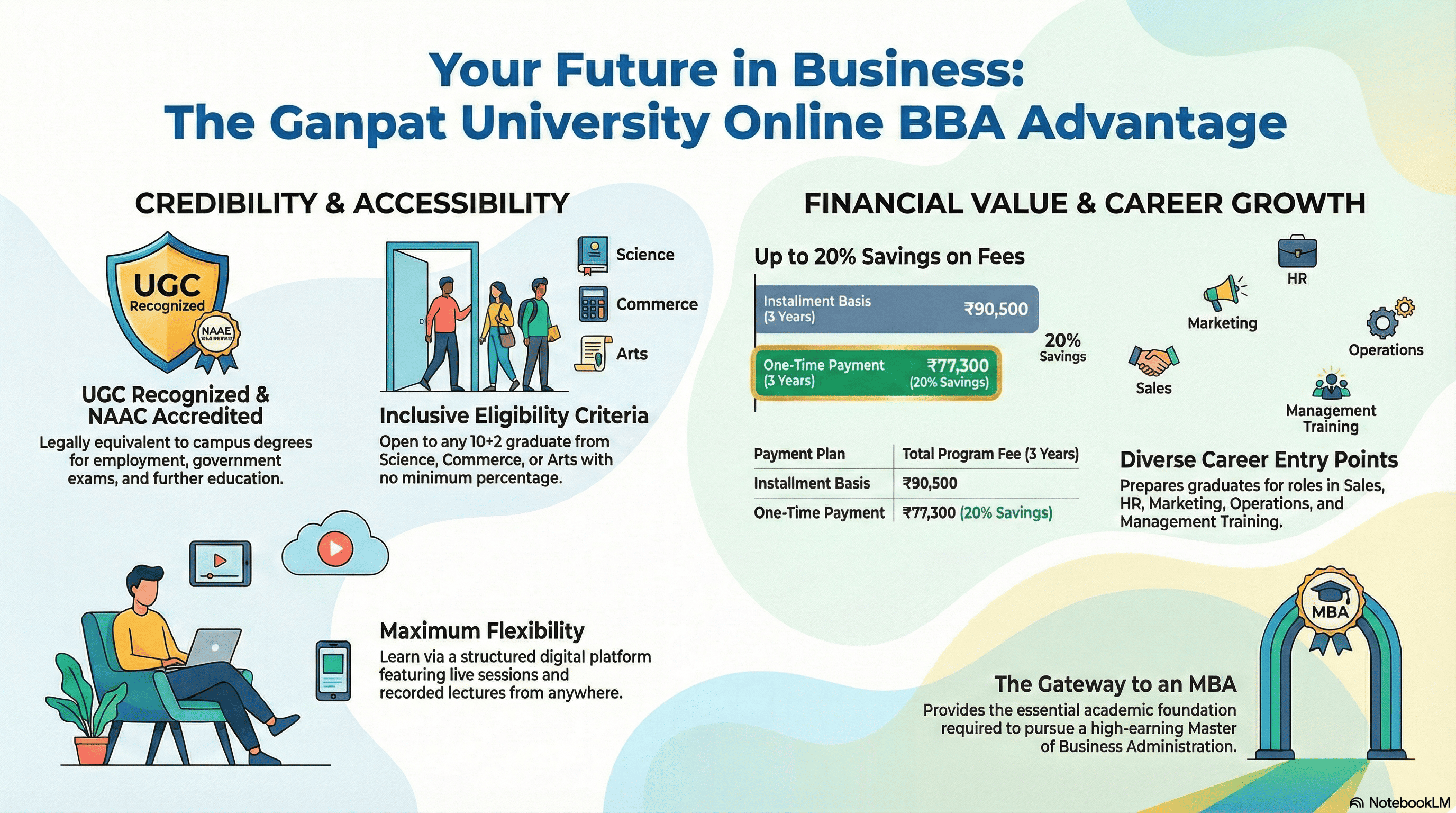
These are fair questions — and they deserve straightforward answers. The Ganpat University BBA programme, offered online, is a UGC-recognised Bachelor of Business Administration degree that carries the same academic standing as a campus-based BBA. It is designed for students who want the structure and rigour of university education with the added benefit of schedule flexibility — whether that is to allow time for skill-building, part-time work, family commitments, or simply a learning pace that suits them better than a fixed campus calendar.
This blog walks you through everything that matters: what the programme offers, what it costs, who it is for, and what kind of career it prepares you for. Written for students deciding their next step and parents evaluating whether online education is the right path for their child.
Overview of Online BBA Programs
Why an Online BBA Makes Sense in 2026
The hesitation around online degrees is understandable — but much of it is based on assumptions that no longer match reality. Online education in India has, over the past five years, moved from the periphery to the mainstream. The University Grants Commission now regulates online degrees with the same standards applied to campus programmes, meaning that a UGC-recognised online BBA is legally and academically equivalent to a regular BBA for employment, further education, and professional qualification.
The practical advantages of an online BBA are significant, particularly for students at the HSC stage. First, it allows you to begin higher education without relocating or committing to a rigid daily schedule, which is especially valuable if you are uncertain about moving away from home immediately after school. Second, it creates time for the kind of skill development — certifications, internships, language learning, digital tool proficiency — that makes a difference in the job market, but that a packed campus timetable often does not permit. Third, it is financially more accessible, with lower overall costs than residential programmes when accommodation, transport, and living expenses are factored in.
For parents, the online format offers a specific reassurance: your child is enrolled in a recognised university programme with a structured curriculum, faculty oversight, and formal assessment — but with the added security of being at home during a developmentally formative stage. The degree provides the same qualification outcome, while the format provides a level of parental visibility and student support that campus life does not.
About Ganpat University: The Institution Behind the Programme
Ganpat University is a recognised institution in Gujarat, established under the Gujarat Private Universities Act and accredited by the National Assessment and Accreditation Council (NAAC). The university offers programmes across engineering, management, pharmacy, and applied sciences, with a particular focus on aligning academic education with employability and entrepreneurship.
The online BBA programme at Ganpat University is delivered through a structured digital platform that combines recorded lectures, live interaction sessions, digital study materials, and faculty support — designed to replicate the academic rigour of a campus programme in a format that students can access from anywhere. The programme is governed by UGC's regulations for online and distance learning, which means it meets the same curriculum, faculty qualification, and assessment standards as the university's on-campus offerings.
For students and parents evaluating the credibility of the programme, the key markers are: UGC recognition, NAAC accreditation, and a track record of graduate employment and further education outcomes. Ganpat University meets each of these criteria, making its online BBA a credible pathway for students who want a business education foundation without the constraints of campus attendance.
Eligibility: Who Can Apply for the Online BBA Programme
The eligibility requirement for admission to the online BBA programme at Ganpat University is straightforward: candidates must have successfully completed their Higher Secondary Certificate (10+2) examination from a recognised board in any stream — Science, Commerce, or Arts. There is no minimum percentage requirement, which makes the programme accessible to a wide range of students, including those whose HSC results may not have been strong enough for highly competitive campus admissions but who are motivated to build a business career.
This eligibility structure reflects a principle that is increasingly common in online higher education: the barrier to entry is intentionally lower, but the expectation is that students will engage seriously with the programme once enrolled. The online format does not reduce the academic standard — it changes the entry gate.
For parents concerned about whether their child is ready for the self-directed nature of online learning, the honest answer is that readiness is not just about academic capability — it is about motivation and discipline. A student who has a clear sense of why they are pursuing a BBA and what they intend to do with it will thrive in the online format. A student who is enrolling because it feels like the path of least resistance may struggle.
Programme Fees: What the Online BBA at Ganpat University Costs
The Ganpat University BBA fees for the online programme are structured to be financially accessible while maintaining the quality and recognition of a full university degree. The total programme fee for the three-year BBA is ₹90,500 when paid in instalments across the duration of the programme.
For families who are in a position to pay the full fee upfront, Ganpat University offers a 20% discount on the total amount, reducing the cost to ₹77,300 for the entire three-year degree. This one-time payment option provides significant savings and is worth considering for families who have the financial capacity to commit the amount at the time of admission.
To put this in context: the total cost of a campus-based BBA at a comparable institution in Gujarat, including tuition, accommodation, meals, and transport, typically ranges between ₹2 lakh and ₹4 lakh over three years. The online BBA at Ganpat University delivers the same qualification for a fraction of that cost, making it one of the most financially efficient routes to a recognised business degree in the state.
For students who may need to supplement their family's financial contribution, the online format has an additional advantage: it allows time for part-time work or freelancing alongside study, which is considerably harder to manage in a full-time campus programme.
What You Will Learn: The BBA Curriculum at Ganpat University
The online BBA curriculum at Ganpat University follows the structure prescribed by UGC for business administration programmes, covering the foundational domains that every business graduate needs: principles of management, accounting and financial management, business economics, marketing management, human resource management, business law, and business communication.
The programme is organised across six semesters, with each semester structured around core subjects, elective options, and project-based assignments that require students to apply theoretical knowledge to business scenarios. The curriculum is designed to build cross-functional business literacy — the ability to understand how different parts of an organisation work together — rather than deep specialisation in a single area, which is typically reserved for postgraduate study.
For students, the practical takeaway is this: a BBA does not make you an expert in marketing, finance, or HR. It makes you conversant in all three — and that cross-functional understanding is exactly what most entry-level business roles require. The specialisation, if you choose to pursue it, comes either through work experience or through an MBA.
The learning materials in the online programme include video lectures, downloadable study guides, case studies, and curated reading resources. Assessment is conducted through a combination of internal assignments, term-end examinations (conducted either online under proctored conditions or at designated examination centres), and project submissions.
CTA: Connect with us to explore course structures and admission requirements.
Career Paths After BBA: What This Degree Prepares You For
The most common question from students and parents is: What kind of job can you get after a BBA? The honest answer is that the BBA is not a direct pipeline to a single profession in the way that an engineering or medical degree is. It is a general management degree that opens multiple doors — and which door you walk through depends on your interests, the skills you build alongside the degree, and the effort you invest in internships and networking during your three years of study.
The career paths most commonly pursued by BBA graduates include:
A structured entry programme offered by large corporations across FMCG, banking, retail, and manufacturing. Trainees rotate through multiple departments before being assigned to a permanent role. Competitive to enter but offers one of the strongest starting points for a business career.
Client-facing roles focused on revenue generation, relationship-building, and market expansion. Available across sectors, including technology, financial services, real estate, and consumer goods. Often, performance-linked income with strong earning potential for results-driven candidates.
Supports campaign execution, digital marketing activities, content creation, and brand communication. Entry roles in this space increasingly require familiarity with analytics tools, social media platforms, and CRM software — skills that can be developed during the BBA through self-learning.
Assists with recruitment, employee onboarding, training coordination, and HR operations. A natural fit for BBA graduates with an interest in organisational behaviour and people management. Entry-level roles are widely available in mid-to-large organisations.
Manages logistics, supply chain coordination, process optimisation, and vendor relations. High demand in e-commerce, retail, and manufacturing. Operations roles offer rapid responsibility growth for organised, detail-oriented graduates.
Supports budgeting, financial reporting, and data analysis in corporate finance departments, banks, or NBFCs. Requires strong numerical skills and proficiency in Excel — capabilities that BBA finance courses develop, but that candidates often need to strengthen independently.
Positions such as relationship officer, credit analyst, or insurance advisor in nationalised banks, private banks, and insurance companies. These roles often involve client interaction, product knowledge, and meeting sales targets.
BBA graduates with a business idea and the initiative to execute, increasingly pursue entrepreneurship directly after graduation. The degree's cross-functional training in finance, marketing, and operations provides a practical foundation for starting and managing a small business.
The MBA Pathway: Building on Your BBA Foundation
For many BBA graduates, the degree is not the endpoint — it is the foundation for an MBA. The BBA-to-MBA pathway is among the most strategically sound academic trajectories available, and understanding why that is the case is important for students planning their long-term careers.
An MBA after a BBA typically doubles entry-level salary potential and accelerates progression into managerial roles by 3–5 years compared to a BBA alone. More importantly, the MBA allows you to specialise in a specific business function — finance, marketing, HR, operations, business analytics — and develop the depth of expertise that the BBA, by design, does not provide.
The timing question is important. Pursuing an MBA immediately after BBA produces a strong generalist qualification but lacks the practical grounding that work experience provides. Pursuing it after 2–4 years of work allows you to bring professional context to the MBA curriculum, which makes the learning more immediately applicable and the placement outcomes typically stronger. For graduates of online BBA programmes, an Online MBA — now widely available from UGC-recognised universities — is a credible and increasingly popular option, particularly for those who have entered the workforce and do not want to pause their income or seniority for two years.
Conclusion
What Students Need to Succeed in an Online BBA
The online BBA format offers flexibility — but flexibility is not the same as ease. The students who succeed in online programmes are those who bring discipline, initiative, and a clear sense of purpose to their study. For students and parents evaluating whether the online route is the right choice, here is what success in this format actually requires.
Self-directed time management is essential. There is no physical classroom to attend, no fixed daily schedule to follow, and no peer pressure to keep you accountable. You set your own study rhythm — and if you do not set one, the programme will feel overwhelming. Students who build a consistent study routine in the first few weeks and stick to it across the semester consistently perform better than those who approach the programme reactively.
Active engagement with course materials matters more in online learning than in campus settings. In a classroom, a good lecturer can hold your attention even if the material is difficult. Online, the responsibility for engagement is entirely yours. Students who succeed are those who take notes actively, pause videos to think through concepts, and seek clarification from faculty when something is unclear — rather than passively watching content and assuming comprehension.
Building skills outside the curriculum is not optional. The BBA provides the academic foundation, but the job market increasingly expects digital proficiency, communication capability, and at least basic familiarity with the tools used in business — Excel, presentation software, CRM platforms, and analytical thinking. Students who invest the time their online format frees up in building these skills graduate significantly more job-ready than those who do not.
Addressing the Common Concerns About Online Degrees
For many parents and students, the decision to pursue an online BBA comes with lingering concerns. These deserve to be addressed directly, with evidence rather than reassurance.
Concern: Will employers accept an online degree? The answer is yes — provided the degree is from a UGC-recognised institution. The regulatory framework in India now treats online degrees from recognised universities as equivalent to regular degrees for employment purposes. Employers in the private sector assess candidates based on capability, not the delivery mode of their education. Government examinations — SSC, banking, UPSC — explicitly accept online degrees from UGC-recognised institutions for eligibility.
Concern: Will my child be disciplined enough for online learning? The honest answer is: it depends. Not on intelligence, but on motivation. A student who has a reason to pursue a BBA — a career direction they are interested in, a skill they want to build, an aspiration they are working toward — will bring the discipline the format requires. A student who is enrolling passively may struggle. The format is not for everyone, but neither is campus education. Different structures suit different learners.
Concern: Will an online BBA close the door to further education? No. UGC-recognised online BBA graduates are eligible for MBA programmes, including competitive entrance exams like CAT, MAT, and university-specific tests. They are eligible for government competitive examinations. They are eligible for postgraduate diplomas and certifications. The pathway forward is identical to that of a campus BBA graduate.
The decision to pursue an online BBA — particularly at a stage as consequential as just after HSC — is not one to make lightly. But it is also not one to dismiss based on outdated assumptions about online education. The Ganpat University online BBA is a UGC-recognised degree that provides the same academic foundation and credential standing as a campus programme, with the added benefit of financial accessibility and schedule flexibility.
For students who are self-directed, motivated by a clear sense of purpose, and ready to use the flexibility of online learning productively, this programme is a strong choice. For parents evaluating whether to support this path, the confidence should come from the facts: the regulatory recognition is sound, the career pathways are open, and the financial efficiency is real. What determines success is not the format — it is the seriousness with which the student engages with it.
Key Takeaways
Here are the essential insights about the Online BBA programme at Ganpat University that will help you make an informed educational decision:
- UGC-Recognised Credential: The online BBA carries the same academic and legal standing as a campus-based degree for employment, government exams, and further education.
- Financial Accessibility: Total programme fee of ₹90,500 (instalments) or ₹77,300 (one-time payment with 20% discount) — significantly lower than residential programmes.
- Flexible Learning Format: Study from anywhere with recorded lectures, live sessions, and digital materials — ideal for students balancing education with other commitments.
- Open Eligibility: Any HSC graduate from any stream (Science, Commerce, Arts) can apply, with no minimum percentage requirement.
- Cross-Functional Business Foundation: Curriculum covers management, finance, marketing, HR, and operations — preparing graduates for multiple entry-level business roles.
- Clear Career Pathways: Graduates pursue roles in management trainee programmes, sales, marketing, HR, operations, finance, banking, or entrepreneurship — with MBA as a strategic next step.
- Success Requires Discipline: The online format rewards self-directed learners who build consistent routines, engage actively with materials, and develop skills beyond the curriculum.
The data clearly shows that Ganpat University's online BBA programme delivers strong value through regulatory recognition, practical curriculum, financial efficiency, and open career pathways — making it a smart choice for aspiring business professionals.
Frequently Asked Questions
Yes. An online BBA from Ganpat University is a UGC-recognised degree, which makes it legally and academically valid across India — including Gujarat — for all purposes: private sector employment, government job examinations, further education including MBA admissions, and professional certifications. The UGC's regulations for online and distance learning ensure that online degrees from recognised universities meet the same academic standards as campus-based programmes. For students in Gujarat, this means an online BBA from Ganpat University holds the same standing as a regular BBA from any recognised institution in the state.
The total programme fee for the three-year online BBA at Ganpat University is ₹90,500, payable in instalments across the duration of the programme. Students who are able to pay the full fee upfront at the time of admission receive a 20% discount, reducing the total cost to ₹77,300. This upfront payment option provides significant savings and is worth considering for families who have the financial capacity to pay at once. Either way, the programme represents one of the most financially accessible routes to a UGC-recognised business degree in Gujarat.
Yes — and for most BBA graduates, an MBA is the most strategically valuable next step. BBA graduates are eligible for MBA admissions through all standard pathways: national-level entrance exams like CAT, MAT, and CMAT; university-specific entrance tests; and direct admission processes at institutions offering MBA programmes. The BBA-to-MBA route is among the most common and academically coherent academic trajectories in business education. An MBA after BBA typically results in significantly better starting salaries, faster career progression, and access to specialised roles in finance, marketing, consulting, or business analytics. For graduates of online BBA programmes, pursuing an online MBA from a UGC-recognised university is an increasingly popular and credible option.
