The Reality Shift: Why MCA Is Becoming a Career Reset, Not Just a Degree
The software industry in 2026 is no longer hiring based on degrees alone it is hiring based on capability, adaptability, and depth of understanding. Yet, a growing number of graduates and early professionals find themselves stuck. They either enter the workforce without a strong technical grounding or plateau after 2–3 years in execution-heavy roles.
This is where an MCA is no longer just an academic upgrade; it becomes a career correction. Whether you are a fresher trying to enter the tech space or a working professional aiming to move beyond support roles into development, architecture, or specialised domains, the degree provides a structured pathway to re-align your trajectory. Understanding MCA course details is therefore not just about subjects it is about recognising how the programme builds the depth required to stay relevant in a rapidly evolving industry.
Where the Market Is Moving: The New Definition of a “Software Developer”
The definition of a software developer has expanded. It is no longer limited to writing code it now includes system thinking, problem-solving, data handling, and working across distributed architectures. Companies are hiring developers who can understand business problems and translate them into scalable solutions.
This is why the relevance of an Online MCA Degree has grown significantly. It allows learners, especially working professionals, to build advanced technical skills while staying connected to industry realities. The flexibility of learning alongside work ensures that concepts are not just theoretical but immediately applied.
Core Software Development Careers MCA Graduates Can Pursue
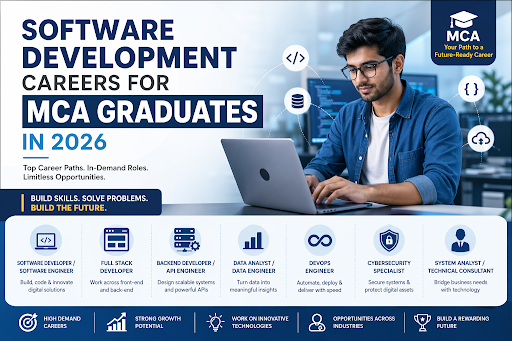
The MCA degree opens doors to multiple career paths within software development. Each role requires a combination of technical skills, conceptual clarity, and practical exposure areas where the programme plays a critical role.
1. Software Developer / Software Engineer
This is the most direct and widely pursued role. Software developers design, build, and maintain applications across web, mobile, and enterprise platforms.
An MCA programme prepares students for this role through:
- Strong foundations in programming languages such as Java, Python, or C++
- Understanding of data structures and algorithms
- Exposure to software development life cycles (SDLC)
- Hands-on project work simulating real-world applications
2. Full Stack Developer
Full-stack developers work across both frontend and backend systems, making them highly valuable in product-based and startup environments.
The MCA curriculum supports this role by:
- Teaching frontend frameworks (HTML, CSS, JavaScript)
- Building backend logic using server-side languages
- Introducing database management systems
- Enabling integration of multiple components into a working system
3. Backend Developer / API Engineer
Backend developers focus on server-side logic, database interactions, and application performance. They are responsible for building scalable and secure systems.
Through advanced modules, the MCA programme equips learners with:
- Database design and optimisation techniques
- API development and integration
- Knowledge of cloud platforms and deployment environments
- Understanding of system architecture
4. Data Analyst / Data Engineer (Software-Focused)
With data becoming central to decision-making, many MCA graduates transition into data-driven roles. While not purely software development, these roles require strong programming and analytical skills.
The programme prepares students by:
- Introducing data handling tools and programming libraries
- Teaching statistical concepts and data interpretation
- Providing exposure to data pipelines and processing systems
5. DevOps Engineer
DevOps engineers bridge the gap between development and operations, ensuring faster and more reliable software delivery.
An MCA programme supports this transition through:
- Understanding of version control systems (Git)
- Exposure to CI/CD pipelines
- Basics of cloud computing and containerisation
- Knowledge of deployment and monitoring tools
6. Cybersecurity Specialist (Software-Oriented)
As digital systems grow, so do security threats. MCA graduates with an interest in secure coding and system protection can move into cybersecurity roles.
The programme helps by:
- Teaching secure coding practices
- Introducing network security fundamentals
- Building awareness of vulnerabilities and threat detection
7. System Analyst / Technical Consultant
System analysts work at the intersection of business and technology, translating requirements into technical solutions.
MCA graduates are prepared for this role through:
- Understanding of system design and architecture
- Exposure to business problem-solving frameworks
- Communication and documentation skills
The Academic–Career Bridge: How MCA Actually Changes Your Trajectory
What makes the MCA different from short-term certifications is its depth. While certifications teach tools, the MCA builds thinking. It connects programming with logic, systems with scalability, and theory with application.
Students who enter the programme often start with fragmented knowledge. By the end, they develop structured thinking, enabling them to solve complex problems and adapt to new technologies. This transformation is what allows them to move into higher-value roles within the IT ecosystem.
Understanding IT jobs after MCA is therefore not just about listing opportunities it is about recognising how the programme equips you to access and sustain those opportunities over time.
Who Should Consider an MCA in 2026?
The MCA is particularly relevant for three categories of learners:
- Fresh graduates who want to enter the IT industry with a strong technical foundation
- Working professionals (0–3 years experience) who want to shift from support or testing roles into development
- Career switchers from non-technical backgrounds who have studied mathematics and want to move into software roles
For all three, the programme acts as a structured pathway to reposition their careers.
Eligibility Criteria
To enrol in an MCA programme, candidates typically need a graduation background that includes exposure to quantitative or technical subjects. In simple terms, you are eligible if you have completed a bachelor’s degree in commerce, management, science, or any discipline, provided you studied Mathematics, Statistics, Computer Science, IT, or related subjects either during your degree or at the 10+2 level.
Most universities require a minimum of 50% aggregate marks (with a relaxation to 45% for reserved categories). This ensures that students entering the programme have the foundational analytical ability needed to succeed in a technical curriculum. Understanding MCA eligibility is important because it determines whether you can transition into the programme and build a long-term career in technology.
The Bigger Picture: Why MCA Graduates Will Remain Relevant
The demand for software professionals is not slowing down; it is evolving. Roles are becoming more specialised, expectations are increasing, and companies are prioritising depth over surface-level skills.
An MCA provides the structured learning required to keep pace with this evolution. It does not just prepare you for your first job; it prepares you for your next five roles. That is the real value of the programme.
FAQs
The curriculum typically includes programming, data structures, database management, software engineering, operating systems, and emerging technologies like AI and cloud computing.
Yes, as long as you have studied Mathematics or a related subject at some stage, you can transition into the programme and build technical skills from the ground up.
If the programme is recognised and approved, it holds equal value in terms of academic credibility and career opportunities.
IT services companies, product-based firms, startups, consulting firms, and even non-tech industries with digital operations actively hire MCA graduates.
It builds strong technical foundations, enabling professionals to move into senior roles such as tech lead, architect, or specialised domain expert over time.
Key Takeaways
- MCA is no longer just a degree; it is a strategic career move
- It bridges the gap between basic knowledge and industry-ready skills
- Software development roles are expanding, not shrinking
- The programme prepares you for long-term growth, not just entry-level jobs
- Choosing the right MCA can redefine your entire career trajectory
