Why Online Degree Validity Is the #1 Career Risk Students Ignore
A candidate clears multiple interview rounds at a reputed firm, only to be rejected at the final stage. The reason? The degree submitted for verification was not recognised under the required regulatory framework. No lack of skills, no performance issue—just a validity gap. This is the silent risk most students underestimate when choosing an online programme.
In today’s evolving education landscape, access has increased, but so has ambiguity. Students often focus on course content, fees, or placement claims, while overlooking the single factor that determines long-term value—whether the degree will be accepted by employers, government bodies, and global institutions. This is where understanding how to verify online degree validity in India becomes essential, not optional.
This guide will walk you through the exact verification process, regulatory checkpoints, programme comparisons, and decision frameworks required to ensure that your degree supports—not limits—your career trajectory.
The Core Rule: UGC-DEB Is Your Final Checkpoint — Not Just Any "UGC Approved" Label
A major source of confusion for students is the assumption that a “UGC-approved” university automatically offers valid online degrees. This is not entirely accurate. The University Grants Commission (UGC) governs higher education institutions, but online and distance learning programmes fall under the Distance Education Bureau (DEB).
This distinction is critical because only a UGC-DEB approved online degree ensures that the programme meets the regulatory standards required for recognition. Many universities may be listed under UGC, but their online programmes may not be approved for a specific academic cycle.
Students often miss this nuance, leading to enrolment in programmes that lack formal approval. The implication is serious—degrees may not be accepted for jobs, competitive exams, or further studies. Therefore, the final checkpoint is always DEB approval, not just institutional recognition.
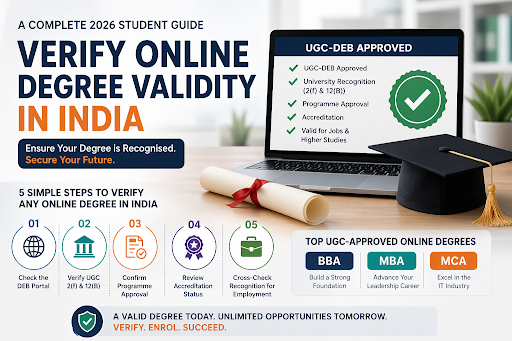
5 Simple Steps to Verify Any Online Degree in India (Step-by-Step Walkthrough)
Before enrolling in any programme, it is essential to follow a structured verification process. If you are asking yourself is online degree valid in India, these steps will give you complete clarity:
- Step 1: Check the DEB Portal - Visit the official Distance Education Bureau portal and confirm whether the university and programme are listed for the current academic session.
- Step 2: Verify UGC Sections 2(f) and 12(B) - Ensure that the university is recognised under these statutory provisions.
- Step 3: Confirm Programme Approval - Do not assume all courses are approved—check your specific programme.
- Step 4: Review Accreditation Status - Look at NAAC grades or NIRF rankings for additional credibility.
- Step 5: Cross-Check Recognition for Employment - Verify whether the degree is accepted by UPSC, PSUs, and private employers.
Following these steps ensures that your decision is backed by regulatory validation rather than assumptions.
Look for Programme-Specific Approval — Not Just University-Level Recognition
One of the most common mistakes students make is relying solely on university-level recognition. However, approval for online education is granted programme-wise and for specific time periods.
When evaluating a UGC approved online university in India, it is important to understand that not all programmes offered by that university may be approved at the same time. A university may have approval for an MBA but not for an MCA in a particular academic cycle.
This makes it crucial to verify the exact programme name, duration, and intake year on the DEB portal. Ignoring this detail can result in enrolling in a programme that does not hold formal recognition despite being offered by a legitimate institution.
Verify the University's Statutory Recognition: What Section 2(f) and 12(B) Mean for You
Statutory recognition forms the legal backbone of a university’s authority to offer degrees. Sections 2(f) and 12(B) under the UGC Act determine whether an institution is officially recognised and eligible to operate within the higher education framework.
For students trying to understand how to check a fake online degree in India, this is one of the quickest and most reliable checks.
- Section 2(f): Confirms that the university is recognised by UGC
- Section 12(B): Allows the university to receive grants and operate fully
If a university is not listed under these sections, it raises serious concerns about the legitimacy of its programmes. This verification step is simple but extremely powerful in avoiding invalid degrees.
India’s Most In-Demand UGC-Approved Online Degrees in 2025 — MBA, MCA & BBA
The demand for online education is increasingly aligned with industry needs. Among the most sought-after programmes are BBA, MBA, and MCA, each catering to different career stages and aspirations.
| Degree | Eligibility | Duration | Career Outcomes | Salary Range |
|---|---|---|---|---|
| BBA | 10+2 | 3 Years | Business operations, entry-level management roles | ₹3–6 LPA |
| MBA | Graduation | 2 Years | Leadership, consulting, managerial roles | ₹6–15 LPA |
| MCA | Graduation (IT/CS preferred) | 2 Years | Software development, IT roles | ₹5–12 LPA |
Students exploring an online MBA UGC approved India typically aim to transition into leadership roles where strategic thinking and decision-making are essential.
For early-stage learners, understanding whether An online BBA degree is valid in India helps in building a strong academic foundation that supports future specialisations.
For technical professionals, an online MCA UGC DEB approved programme provides the skills required to stay relevant in a rapidly evolving digital economy.
Relevant programme links:
Explore UGC-DEB Approved Degrees at Ganpat University Online — BBA, MBA & MCA
When evaluating programme options, credibility indicators such as accreditation, rankings, and regulatory approvals become key decision drivers. Platforms like Ganpat University Online official site provide structured information on programme offerings, approvals, and admission timelines.
With NAAC “A” accreditation and GSIRF 5-star rating, the institution positions itself within a credible academic ecosystem. The April 2026 admission timeline also makes it relevant for students planning immediate enrolment.
Why Your Degree's Validity Directly Shapes Your Career Ceiling
The validity of a degree influences every stage of your professional journey—from your first job to long-term career growth. For many students, the key concern is whether An online degree is valid for government jobs in India.
Government bodies, PSUs, and even private organisations follow strict verification processes. Degrees are evaluated against official regulatory databases, and any mismatch can lead to rejection.
Beyond employment, validity impacts:
- Eligibility for competitive exams
- Admission to international universities
- Internal promotions and role transitions
- Salary negotiations and career mobility
In essence, a valid degree expands your opportunities, while an invalid one restricts them significantly.
The Right Degree for the Best Opportunity: Choosing Between BBA, MBA & MCA Online
Selecting the right programme requires aligning your current position with your future goals.
- Freshers can consider a >3-year online BBA
- Working professionals may opt for a 2-year online MBA for working professionals to move into leadership roles
- Technical graduates can pursue a 2-year online MCA for CS graduates to strengthen their domain expertise
Each programme serves a different purpose, and the right choice depends on your career stage, industry preference, and long-term aspirations.
How to Spot a Fake or Invalid Online Degree — 7 Red Flags Every Student Must Know
With the rise of online education, fraudulent programmes have also increased. Identifying warning signs early is crucial.
If you are unsure is online degree valid in India, look out for these red flags:
- Absence from the DEB portal
- No mention of UGC 2(f) or 12(B) recognition
- Extremely short or unrealistic course durations
- Guaranteed placement claims without transparency
- Lack of accreditation details
- Poor or missing official website
- No structured admission or evaluation process
These indicators can help you avoid programmes that may not hold long-term value.
How Ganpat University Online Simplifies Your Verification Process
Verification can often feel complex, especially for first-time applicants. Institutions that provide transparent access to information make this process easier.
Check mandatory disclosure so that students and parents can directly review approvals, programme details, and compliance documents in one place. This reduces ambiguity and builds trust in the decision-making process.
Practical Takeaways — Your 3-Step Action Plan Before You Enrol Anywhere
Step 1: Verify DEB and UGC approvals
Step 2: Confirm programme-specific recognition
Step 3: Align the degree with your career goals
If you are ready to move forward, you can explore options such as:
Making an informed choice today ensures that your degree supports your career for years to come.
FAQs
Yes, the university’s online programmes are approved under the regulatory framework defined by UGC-DEB, subject to specific academic cycles and programme listings.
Recognition abroad depends on the destination country and institution. However, degrees from recognised Indian universities are generally accepted for further evaluation.
Candidates must have completed 10+2 (HSC) from a recognised board.
A bachelor’s degree from a recognised university is required.
Only a bachelor’s degree is required.
Absence from DEB listings, lack of UGC recognition, unrealistic claims, and missing accreditation are key indicators.
No, if the programme is approved by UGC-DEB, the degree holds the same value as a conventional degree in terms of recognition.
Final Thought
In today’s education landscape, the question is no longer just “What should I study?”—it is “Will this degree stand the test of verification?” Making the right choice requires clarity, not assumptions. And that clarity begins with understanding validity.
